Where Am I From?

I am from a neighborhood filled with family and friends 

Cousins on both sides 

Always around to go for a bike ride 

From daycare to schoolyards to soccer fields to tennis courts 

To cheer practice and Fridays spent on the football field 

I am from a wide array of activities 

Activities which involved my parents there every step of the way 

And where nothing was taken for granted any day 

I am from weekly family dinners and weekend sleepovers 

I am from summer camp in the summertime and 

Sunshine, overwhelming smell of sunscreen, and trips to the sandbar

I am from love and a family that never gives up 

A family who encourages me and is my backbone every step of the way 

Even through my ups and down 

Reading Response 4

As I was reading the 1619 Project on the New York Times, I was personally astonished and moved from the stories and quotes. Clicking on the link, I had absolutely no clue it would be as brutal and real as it is. The website was designed intricately by having different links leading to articles and quotes which could be read by scrolling horizontally and vertically.It truly brings out the horrors of slavery and the extreme mistreatment of African Americans during slavery and years after. I have always learned about slavery, but I have never truly engrossed myself in articles from people personally affected by slavery and hear from their point of view. 

For starters, the set up is more on the dark side to represent the intense stories with impactful quotes. The quotes do not sugarcoat slavery whatsoever as they should not. The powerfulness of these quotes truly show how hard times were during slavery for African Americans and how it is not okay to discrimiate and hate. It saddens me to think that anyone had to go through what people put slaves through. For example, I was shocked to find out Angola made their prisoners pick cotton. The systems of the government were so backwards at this time because the economy was obviously their top priority, which they strengthened through capitalism. The fact any law officer thought making prisoners pick cotton to help the southern economy is horrible. Growing up in Louisiana, I have heard and learned so much about Angola, but I have never learned that Angola was built on slave plantations, and it is larger than Manhattan! These two facts blow my mind because Angola is a part of Louisiana where most of us have been born and raised. Hearing all of this from Bryan Stevenson was intriguing because I feel as if I understand him through reading Just Mercy, so reading his further opinion on slavery and the Criminal Justice system was moving to me. 

Finally, I skimmed through multiple articles which also all embraced and emphasized the negative impacts slavery has had on our society as a whole. Not only was there bias on the streets and amongst people, but there was also racial disparities in the courtroom. The government should be something people feel safe with and can trust, but having slavery in our history, there will always be skeptism and fear of the government that their is still bias remaining in the Criminal Justice System. I can say I learned a great deal of new information from reading this project and was truly impacted by reading all of these author’s points of view on slavery and the biasness that is still in play today. I can only hope that the lingering racial disparities existing today can come to an end and everyone can have the ability to live their life without the fear of being discriminated. 

Reading Response 3

Intellectual humility is a term that is often neglected amongst high school students. It is defined as “recognizing the limits of one’s knowledge and valuing the insight of someone else.” This concept is dismissed by most students as everyone strives to be the best and “top of the class,” yet in reality, this is not the case. In The Benefits of Admitting When You Don’t Know, by Tenelle Porter, it is evidently described that it is a major cultural issue in which people do not accept nor do they admit their mistakes. It is ignorant of any human to not own up to their mistakes and dogmatize other’s mistakes. 

The idea of growth versus a fixed mindset struck me and intrigued me. Growth mindset is the belief that one’s intelligence is constantly changing and improving, while fixed mindset is the belief that you either have intelligence or you do not. With this idea fresh in my head, I was able to connect in to the article Why Facts Don’t Change Our Minds, by Elizabeth Kolbert. People tend to shut down when their ideas are refuted. This is because people’s growth mindset set them up in situations to oppose and dismiss others opinions and beliefs due to their belief that there is only one right answer and no creativity is allowed. 

Growth versus fixed mindset is apparent in sports. From experiencing it first hand in tennis to watch it with my own eyes watching other sports, such as football, baseball, basketball, and more, I realize a fixed mindset is degrading to other teammates and even for the person themself. For example, in tennis, people think there is one “good and right” way to hit a forehand or serve, but really there are infinite ways to hit a forehand or serve. You are not defined as good or not just depending if one person thinks you hit the right way. It astonishes me that people are so stubborn and fixed on one right answer, one right way to hit, or one right way to be socially accepted that they do not take the time to step back and admire someone else’s uniqueness and different self. I have come to some concluding questions which are, how do we learn intellectual humility and how can we get out of the fixed mindset and a growth mindset? I will dwell on these questions and consider ways that, as a society, we can work to help build each other up and move away from fixed minsets.

Reading Response 2

As I read Schools are Missing What Matters Most About Learning, the excerpt from How To Fly a Horse, and watched the TED Talk, Do Schools Kill Creativity, I reflected and came to the conclusion that creativity is crushed by education. In How to Fly a Horse, the quote on page eighteen, which reads “everyone is born creative; everyone is given a box of crayons in kindergarten. Being suddenly hit years later with the ‘creative bug’ is just a wee voice telling you, ‘I’d like my crayons back, please,’” connects all of the ideas from all the documents simultaneously.  

As we began our education in Pre-K through 3rd grade, we were all eager and bright-eyed to see the world and learn. We applied our knowledge in a multitude of ways through games, arts and crafts, and hands on learning. Creativity was a part of our daily lives due to the fact our little selves were so eager to immerse ourselves in a new project. However, as we slowly aged, our creativity slowly diminished and is still diminishing to this day. Even though, in Schools are Missing What Matters Most About Learning, David Mercado states how gifted curiosity is an obvious characteristic that contributes to academic success, but this statement does not stand for older kids. As we have gotten older, our teachers do not engrain in us anymore about the creativity side. Teachers tend to squander students ideas because they see everything as right and wrong in which they do not accept mistakes and slip ups. As we grow older I do believe that we need to be punished and learn what we should and should not do to help us grow into our adult years, but I do believe there is always still room for curiosity in high school and even as an adult. 

Thus, these three documents have made me realize it will take us, as students, to accept the creativity side and still “have our crayons” because our creativity is what makes us unique and true to ourselves. Not only does it help us accept ourselves, but creativity sparks our education and eagerness to learn. We can all work on bringing back out our creative side and hopefully influence others into bringing out their creative side as well. 

Reading Response 1

After reading the two articles, Agonism in the Academy and The Dangers of Certainty, I have realized that thinking is a complex matter that involves many different aspects in the ways people think about it. Agonism which is a “ritualized opposition” is evident in most academic settings. Sometimes it is promoted and encouraged by teachers who think the way to get better is by tearing one another down. In Agonism in the Academy, Deborah Tannen dwells on how people are more focused on each other’s faults than on what one another’s strengths are. This causes vulnerableness and defensiveness which leads to people unwilling to speak their mind and bring new ideas to the table. People avoid taking part in “adversarial discourse” because they are scared to show their work and fear being torn down. Agonism causes divisiveness which causes people to not want to work to a new level of succession. I find that the agnostic culture is more prevalent than we might think. Students tend to tear down their peers work in order for them to gain more confidence and the feeling of being better than. For example, when grades come out for a big test or a dreaded exam, people jump to the question, “What did you make?” I find this simple question extremely irritating and defeating because a grade does not define intelligence whatsoever. People in society are always trying to one up each other and most of the time, they achieve this by tearing other people down. 

In The Dangers of Certainty, Simon Critchley gives the reader an exact description of a BBC documentary series called The Ascent of Mari. As described by Critchley, each episode was an “essay” and not flashy or extravagant in any fashion. The part that was so great and admired by all people was that the host, Dr. Jacob Bronowski, held a genuine and humble disposition that made him very well liked. He “presented everything with great gusto, but with a depth that never sacrificed clarity and which was never condescending” (387). He claimed that the people who believe they know everything are corrupted. Knowledge is something gained through accepting uncertainty and being open to reasoning and interpretation. This idea is something we, as humans, can easily opt to avoid due to not wanting to accept the grey areas of knowledge. It is so easy to get in the mindset that there is either a right or wrong solution or everything is black and white. In reality, there is so much depth and meaning to everything, but especially knowledge because knowledge is such a diverse topic with a wide array of rights and wrongs to it. Overall, thinking and egos are two things that make us who we are, but sometimes they can cause corruption.

Self Portrait Commentary

Julia Frazer 

Mrs. Sutcliffe 

Seminar 

9 August 2019 

Collage Commentary 

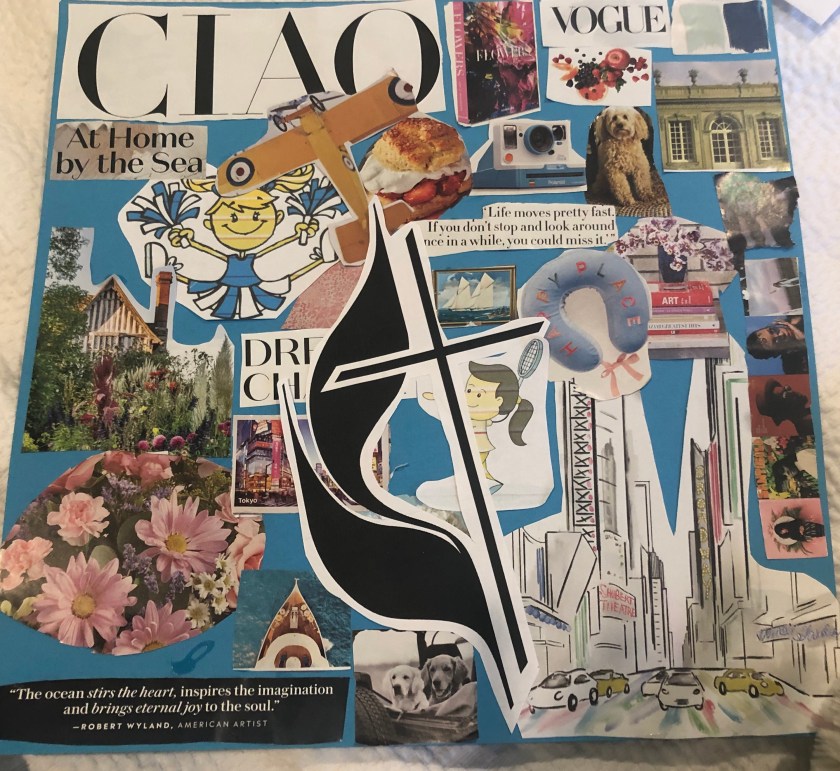
For the “Self-Portrait” assignment, I chose to make an abstract collage that represents me in the best way possible. I spent time searching through magazines for pictures, drawings, quotes, and words that show my personality and what I believe in. I have always had a passion for art projects and getting to show my creative side through art. 

One thing I believe that makes me more interesting is traveling and expanding my horizons. I visually show this in my collage through pictures of places around the world, a plane, and quotes. I believe that traveling to different places opens me up to accepting diverse cultures and scenery. A quote that I found that instantly grabbed my attention was: “life moves pretty fast. If you don’t stop and look around once in a while, you could miss it.” In today’s world, it is so easy to get engrossed in living your daily life without the worry of other people or even yourself. I believe that travelling is a humbling experience which shows people the true beauties of the world and that the world does not revolve around us. We are apart of a much bigger world. 

Another trait that makes me who I am is my hobbies. I take part in tennis and cheerleading through school. I like being apart of a team. Through these sports, I get the opportunity to be friends with people I probably wouldn’t get to be friends with otherwise. Participating in team sports not only helps me connect with coaches, friends, and parents, but it also gives me a sense of accomplishment and success. It motivates to work hard in all aspects of my life, not just the sport itself. 

My collage represents the full life I lead which includes traveling, hobbies, friends, mentors, sports team, and family. I have a cross in the center which overlaps and connects all aspects of the collage. This represents how faith and my belief in God provides all this goodness in my life for me. It is with his power, strength, wisdom, and love that I am able to embrace and enjoy all these aspects of my life.

Just Mercy Reflection

Julia Frazer

Mrs. Sutcliffe

Seminar

9 August 2019

                                             Character in the Social Justice System

         Just Mercy by Bryan Stevenson compelled me to think profoundly about the treatment of incarcerated individuals. These individuals in the novel were mostly falsely accused, yet were punished through the criminal justice system despite possible innocence.  The story of Mr. Ruffin towards the beginning of the novel made an impression on me. It stunned me how these jail officials got away with beating Mr. Ruffin and denying him his medication to the point of death (Stevenson 37). This individual’s traumatic experience shocked me, however, there were daily instances of verbal and physical abuse by the jail officials in all prisons.

         On page eighteen Stevenson says, “I’ve come to believe that the true measure of our commitment to justice, the character of our society, our commitment to the rule of law, fairness, and equality cannot be measured by how we treat the rich, the powerful, the privileged, and the respected. The true measure of our character is how we treat the poor, the disfavored, the accused, the incarcerated, and the condemned.” This quote struck me, along with Stevenson’s powerful examples of real people who have suffered this injustice. His influential narrative concerning his beliefs about the absence of compassion for all people is very relative to my world.

         This quote not only describes the criminal justice system, but life in general. I specifically can relate it to my feelings about how people are treated as teenagers. I fully believe that everyone should show compassion and grace to all people despite any differences. I also believe we should take it a step further and stick up for people even if it requires risking our status amongst our peers. As I have witnessed in my high school life and observed in the criminal justice system over the years, we are denouncing ourselves the same as the victim if we don’t take a stand for people who are persecuted, left out, and mistreated.

Overall the message of the book, which is exemplified by the quote I chose, moves me as I have the utmost respect for Stevenson’s profession and the way he helps people out of true selflessness. Displaying mercy for all people is significant in day-to-day life and in the criminal justice system. 

Then they came for the Jews

And I did not speak out- 

Because I was not a Jew. 

Then they came for the communists 

And I did not speak out- 

Because I was not a communist. 

Then they came for the trade unionists

And I did not speak out- 

Because I was not a trade unionist.

Then they came for me – 

And there was no one left 

To speak out for me. 

-Martin Niemöller

This quote is one that I keep on my bulletin board as a reminder of how to live my life. It depicts the message of Just Mercy.  To me, this exemplifies why we should find our voice and stand for others. My parents have always urged me to follow this quote and I strive to live by it. I believe this is partially why Brynan Stevenson resonates so much with me because I feel as if he looks at falsely accused people and considers it as his chance to defend them and to make a difference in the world. His writing is so powerful to me because I believe anyone can start doing this now amongst their peers who are outcasts or wrongly accused.